Analytics Integrations
What Is an Impressum? Who Needs One and What to Include
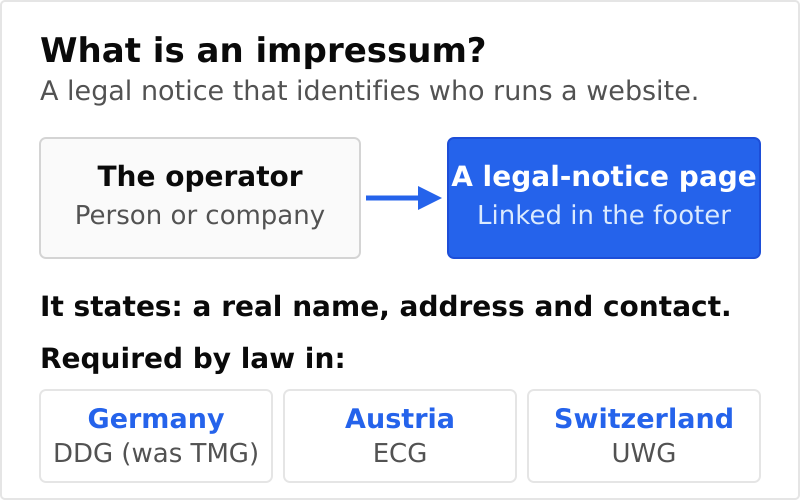
So what is an impressum? An impressum is a legal notice that identifies who runs a website — the person or company behind it, where they’re based, and how to reach them. If you operate a business-like website that’s accessible in Germany, Austria, or Switzerland, you almost certainly need one. This isn’t a privacy policy and it isn’t optional decoration. It’s a named legal duty, and the law behind it in Germany changed recently in a way most online guides haven’t caught up with.
From a business perspective, the impressum matters because the usual consequence of getting it wrong isn’t a Google ranking dip — it’s a formal warning letter (an Abmahnung) demanding that you fix the page and promise in writing not to repeat the mistake. Who can send that letter, and who can bill you for it, changed in 2020 in a way that most English-language guides still miss. So it’s worth understanding exactly who’s on the hook, what the notice has to say, and what really happens when it’s missing.
What is an impressum in plain terms
An impressum is a mandatory legal notice that states who is responsible for a website. The word is German, and there’s no clean English equivalent, which is why English-speaking site owners often miss it entirely. The closest term is a legal notice — sometimes written as “site notice” or, less accurately, “imprint.” Its single job is identification: it tells visitors and authorities exactly who they’re dealing with.
Think of it as the digital version of the address and registration details a brick-and-mortar shop has to display. A reader landing on your site should be able to find a real name, a real postal address, and a working way to contact you within a click or two. Germany, Austria, and Switzerland each have their own law requiring this, which is why the duty trips up businesses that serve a German-speaking audience without realizing they fall under it.
The impressum is usually a dedicated page, linked clearly in the footer with a label like “Impressum,” “Legal Notice,” or “Site Notice.” It has to be reachable from anywhere on the site — typically two clicks or fewer — and it can’t be hidden inside a contact form or buried in fine print.
Who needs an impressum?
The short version: if your website is anything other than purely private and non-commercial, assume you need one. The laws don’t care whether you call yourself a business. They care whether your site has a commercial or business-like purpose.
In Germany, the duty applies to “business-like” digital services — which courts read broadly. Here’s the practical breakdown of who’s covered:
- Companies and freelancers — any commercial website, online shop, or professional services site. No exceptions.
- Sites that run ads or affiliate links — monetization makes a site business-like, even a “personal” blog.
- Sites with a marketing or lead-generation purpose — if it exists to grow a business, it counts.
- Larger content sites and influencers — regular publishing aimed at an audience is generally treated as business-like.
- Associations, clubs, and NGOs with an outward-facing presence.
The narrow exception is a genuinely private site: a personal page with no ads, no affiliate links, no business intent, and no monetization. In practice, that’s a small slice of the web. The moment money or marketing enters the picture, the exemption evaporates.
Quick test: Could your website plausibly help you earn money, win clients, or build a commercial audience? If yes, treat the impressum as required.
One point that surprises people: charging for the service is not the trigger. The German statute covers services “usually offered for a fee,” which catches free blogs and free tools whose category is normally commercial. A free ROI calculator published by a consultancy is business-like even though nobody pays to use it.
This is also where the geography catches people out. The duty attaches to who’s offering the service, not just where the server sits. A German-registered company needs an impressum regardless of where it hosts. Austria and Switzerland apply their own versions to operators based there. We’ll come back to the cross-border case below, because that’s the question we get most.
German impressum requirements: the full field list
The required fields are remarkably consistent across the German-speaking countries, because they all aim at the same thing: unambiguous identification of the operator. Germany’s version is the strictest and the most litigated, so building to it is a safe baseline for the whole region.
The German list lives in § 5 DDG, which opens with the sentence that decides most disputes: providers must keep the information “leicht erkennbar und unmittelbar erreichbar” — easily recognizable and immediately reachable — and “ständig verfügbar,” permanently available. Eight numbered items follow. Here they are with the practical reading of each.
| Field | Required for | Notes |
|---|---|---|
| Full name (and legal form, e.g. GmbH) | Everyone | § 5(1) no. 1. For companies, the registered company name, the legal form, and the authorized representatives. |
| Postal address | Everyone | § 5(1) no. 1. A real physical address where documents can be served — no PO box. |
| Email address | Everyone | § 5(1) no. 2 names email explicitly, alongside “rapid electronic contact.” |
| Phone number | Strongly recommended | Not named in the statute, but it’s the uncontested way to satisfy the direct-contact half of no. 2. |
| Supervisory authority | Licensed activities | § 5(1) no. 3. Only where the service needs official authorization — brokers, insurers, care services. |
| Commercial register entry + number | Registered companies | § 5(1) no. 4. Register type, registering court, and the HRB/HRA number. |
| Regulated-profession details | Regulated professions | § 5(1) no. 5. Chamber, professional title, the state that granted it, and where the professional rules can be read. |
| VAT ID (USt-IdNr.) | VAT-registered businesses | § 5(1) no. 6. If you hold one, list it. There’s no duty to obtain one just for the notice. |
| Liquidation status | Companies being wound up | § 5(1) no. 7. Stock corporations and similar forms in liquidation must say so. |
| Person responsible for content | Editorial content | Not in the DDG at all — this one comes from § 18(2) MStV, the media state treaty. Full name and address of a natural person. |
Two details cause most of the trouble in practice. The address must be a genuine place where you can be served documents, which rules out a PO box and rules out a virtual-office arrangement that forwards mail with no real presence. And the last row is the one people forget. § 18(2) of the Medienstaatsvertrag obliges providers of journalistic-editorial offerings to name a responsible person — a human being with a name and an address, on top of the company details. The statute aims squarely at services that reproduce press-style periodical content, and whether an ordinary company blog qualifies is genuinely debated; German practitioners usually advise naming someone anyway, since the line is fuzzy and the entry costs nothing. Blogs run by a one-person business name the same person twice, which is fine.
Where the impressum has to sit
“Easily recognizable and immediately reachable” is not a style guide — it’s the wording courts apply. The settled reading comes from the Federal Court of Justice in Anbieterkennzeichnung im Internet (BGH, 20 July 2006, I ZR 228/03): a legal notice reachable through two links, labeled “Kontakt” and then “Impressum,” satisfies the requirement. Two clicks are enough; a hunt through unlabeled pages is not.
What that means for your footer:
- Label it with a word people recognize. “Impressum” and “Kontakt” were both accepted by the court as customary. Invented labels like “About the operator” invite argument.
- Put the link on every page, not only the homepage. “Permanently available” is read as site-wide.
- Keep it as text, not an image or PDF. The details have to be readable and copyable without extra effort.
- Don’t gate it behind a form. A contact form is not a contact address; the email has to be visible.
A minimal impressum you can copy
Here’s the skeleton for the two most common cases. Treat it as a starting structure, not legal advice — the field list above tells you which lines your particular business has to add.
A freelancer or sole trader:
Impressum

Anna Beispiel
Beispielstraße 12
10115 Berlin
Germany

E-Mail: kontakt@example.de
Telefon: +49 30 12345678

Umsatzsteuer-Identifikationsnummer
gemäß § 27a UStG: DE123456789
A limited company with editorial content:
Impressum

Beispiel GmbH
Beispielstraße 12
10115 Berlin
Germany

Vertreten durch: Anna Beispiel, Geschäftsführerin
E-Mail: kontakt@example.de
Telefon: +49 30 12345678

Registergericht: Amtsgericht Berlin-Charlottenburg
Registernummer: HRB 123456
Umsatzsteuer-Identifikationsnummer: DE123456789

Verantwortlich für den Inhalt nach § 18 Abs. 2 MStV:
Anna Beispiel, Beispielstraße 12, 10115 Berlin
Notice what isn’t there: a statute reference in the heading. Plenty of German sites open with “Angaben gemäß § 5 TMG,” and that citation is now wrong — see the next section. Nothing in the law asks you to cite the statute, so the maintenance-free option is to leave it out.
Two more lines you’ll see on German sites that no longer belong there. The first is the EU online-dispute-resolution link that traders had to publish from 2016 onward: the Commission switched the ODR platform off on 20 July 2025 after Regulation (EU) 2024/3228 repealed the rule behind it, so the link now points at nothing and should be deleted. The second is the boilerplate disclaimer about liability for external links, which never had any legal effect.
Does an impressum have to be in German?
This question comes up constantly for international teams, and the answer has two halves that people tend to merge.
There is no duty to translate. German law prescribes the content of the notice, not its language. A site that operates in English for an English-speaking audience can publish its legal notice in English. Equally, a German-language site is under no obligation to add an English version, however helpful that might be for readers abroad.
The obligation itself doesn’t follow the language. A company established in Germany is bound by § 5 DDG no matter which language it publishes in — running the whole site in English does not move you out of German law. The reverse is a real risk too: a business registered outside the DACH region that publishes a German-language site aimed at German readers is treated as addressing that market, and regulators look at substance rather than the registration certificate.
Then there’s the label, which is where most English-language sites go wrong. “Imprint” is the translation you see everywhere, and it’s the weakest choice: in English publishing, an imprint is a publisher’s brand or the printer’s mark on a book, so the word tells an English reader almost nothing about a legal disclosure. As eRecht24 puts it, “imprint” describes the printed impression of print media and belongs to the publishing trade. “Legal Notice” is the standard, clearest option; “Site Notice” and “Legal Disclosure” are also fine.
A practical rule for bilingual sites: keep the word “Impressum” on your German pages, because that’s the term the court called customary and the one German visitors scan for, and use “Legal Notice” on the English pages pointing at the same content. Duplicating the page in both languages is optional; pointing both footers at one accurate page is enough.
Impressum vs privacy policy: the difference
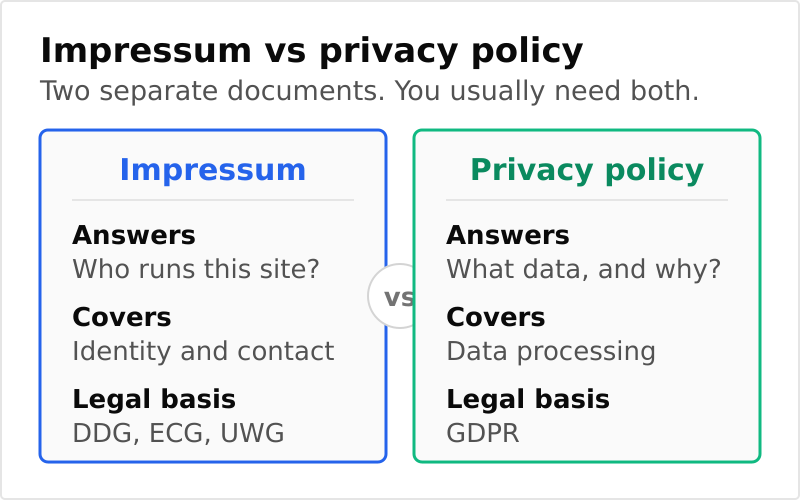
This is the single most common confusion, so let’s be precise. An impressum and a privacy policy are two separate documents with two separate jobs, and you generally need both.
- The impressum answers “who runs this site?” It’s about identification — name, address, contact, registration. Its legal basis is the German DDG (and the Austrian and Swiss equivalents).
- The privacy policy answers “what data do you collect and why?” It’s about data processing — what you track, on what legal ground, who you share it with, and what rights users have. Its legal basis is the GDPR.
Here’s why the distinction matters for anyone running analytics. The impressum doesn’t depend on whether you set cookies — even a site with zero tracking still needs one if it’s business-like. The privacy policy, by contrast, is driven entirely by what data you process. The moment you add an analytics tool, you take on privacy-policy obligations under the GDPR, and often a cookie-consent layer too. They’re triggered by different things, and satisfying one does not satisfy the other.
For the data side of the equation, the privacy policy is a separate document with its own required contents. Keep them as distinct, separately labeled pages. Merging them into one “legal” page is a common mistake that makes both harder to read and weaker if challenged.
The current legal basis: DDG, not the old TMG
If you’ve read other guides on this topic, most of them are out of date — and this is exactly where we can be more accurate. For years, the German impressum duty lived in § 5 of the Telemediengesetz (TMG). You’ll still see countless impressum pages and blog posts that cite “§ 5 TMG.”
That law is gone. On 14 May 2024, the Telemediengesetz was repealed and replaced by the Digitale-Dienste-Gesetz (DDG) — Germany’s Digital Services Act, which implements the EU framework of the same name. The provider-identification duty (the Anbieterkennzeichnung) moved over essentially unchanged and now lives in § 5 DDG. The same day, the cookie statute was renamed from TTDSG to TDDDG, which is why you’ll see both acronyms in guidance written around that date.
Practical takeaway: The obligation itself didn’t change in substance — the same fields are required. What changed is the statute it’s based on. If your impressum still says “Angaben gemäß § 5 TMG,” update it to “§ 5 DDG” or remove the citation.
One reassuring nuance from German legal commentary: there’s no requirement to cite the statute in the impressum at all. Simply labeling the page “Impressum” or “Anbieterkennzeichnung” is sufficient. The same commentary warns that a court could treat a reference to a repealed statute as misleading, which is the reason to act rather than shrug. So the cleanest fix is often to drop the statute reference rather than maintain a number that keeps changing.
What happens when the impressum is missing or wrong
Two separate machines can come after a defective notice, and they work very differently.
The regulatory route. A missing, incorrect, or incomplete impressum is an administrative offense under § 33 DDG, punishable by a fine of up to €50,000. In practice this route is used rarely — state media authorities have limited capacity and reserve it for repeat or egregious cases.
The competition route. This is the one that actually reaches ordinary websites. A competitor or a trade association sends an Abmahnung: a letter naming the breach, demanding you fix it, and asking you to sign a cease-and-desist undertaking backed by a penalty for repetition. For years this was an industry, because the sender could bill their lawyer’s fee to the recipient.
Germany narrowed that in December 2020 with the Act to Strengthen Fair Competition, and the detail matters:
- Competitors can no longer recover their costs for warnings about information and labeling duties online — which covers impressum breaches. § 13(4) no. 1 UWG excludes the reimbursement claim for claimants under § 8(3) no. 1, and the letter itself must say so.
- Small businesses are shielded from the penalty clause. Under § 13a(2) UWG, a competitor cannot extract a contractual penalty on a first warning for those breaches if the recipient regularly employs fewer than 100 people.
- The underlying claim survives. The exclusion is about money, not about the duty — the demand that you correct the page still stands, and ignoring it can still land you in court.
- Associations are not covered by the exclusion. It applies to competitors only. Trade bodies and qualified consumer organizations under § 8(3) nos. 2–4 can still claim their expenses, and they are the ones running systematic sweeps.
So the honest risk assessment for a small site in 2026 is milder than the folklore suggests, but not zero: the cheap mass-mailing model is dead for competitor warnings, while association warnings and the underlying obligation are alive and well. Fixing the page takes fifteen minutes, which is a poor trade against even one letter.
Austria and Switzerland: the same duty, different statutes
Germany isn’t the only jurisdiction with this duty, and the requirements shift once you cross the border.
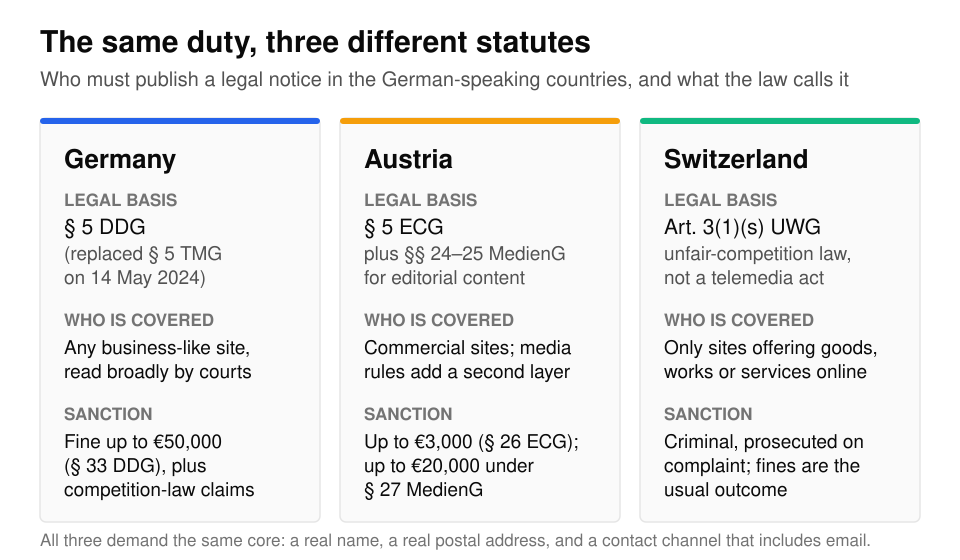
Austria runs two layers. § 5 of the E-Commerce-Gesetz (ECG) carries the general information duty, with additional disclosure obligations under the UGB and GewO for registered businesses and tradespeople; breaching it is an administrative offense with fines up to €3,000 under § 26 ECG. On top of that, §§ 24 and 25 of the Mediengesetz apply to any site with journalistic or opinion-forming content — which includes most company blogs — and § 27 MedienG puts fines of up to €20,000 behind them. An Austrian marketing blog therefore needs both the ECG details and the media-law disclosure.
Switzerland takes a different route entirely. There’s no telemedia statute; the duty sits in Article 3(1)(s) of the Unfair Competition Act (UWG), which makes it unfair competition to offer goods, works, or services in electronic commerce without clear and complete details of your identity and contact address, expressly including an email address. Two consequences follow. The Swiss duty is narrower — it bites only where you actually offer something online, so a purely informational site is outside it — and enforcement is criminal rather than administrative, prosecuted on complaint, with fines the usual outcome. A phone number is not required.
The common thread: every one of these laws demands a real name, a real address, and a working contact channel. Build your notice to the German standard and you’ll comfortably clear the Austrian and Swiss bars too. Country-specific detail lives on our pages for Germany, Austria, and Switzerland.
Do I need an impressum if my site isn’t German but has German visitors?
This is the question that worries international site owners most, so let’s separate the myth from the rule.
The German impressum duty attaches to the operator, not to the audience. If you’re a US, UK, or non-EU company that simply happens to get German visitors, German law generally does not force you to add a German-law impressum just because traffic arrives from Germany. The duty follows where the service provider is established.
But that clean answer has important edges:
- If you have an establishment in Germany — a branch, a subsidiary, an office — you fall under German law for that operation.
- If you’re an EU business, you face the same identification obligation under your own country’s transposition of the EU rules; the wording differs, the duty doesn’t.
- If you actively target the German market — German-language pages, prices in euros, German shipping, marketing aimed at German customers — you should treat full compliance as the safe path, because regulators and competitors look at substance, not just registration.
- Consumer-protection and contact-info rules in many jurisdictions overlap with what an impressum provides anyway, so a clear “who we are and how to reach us” page is good practice regardless.
If German-speaking customers are a real part of your business, the cost of a compliant legal-notice page is trivial next to the cost of an Abmahnung. When in doubt, add one.
For anything genuinely ambiguous — a real establishment question, a regulated profession, a complex corporate structure — this is the point to get advice from a German lawyer rather than rely on a generic guide. The fields are simple; the question of whether the duty catches you is the part worth a professional opinion.
What this means for an analytics or website owner
Here’s the connection most cookie-banner vendors skip. If you’re setting up analytics on a website, you’ve almost certainly built a business-like site — which means the impressum question is already on your desk, sitting right next to the privacy and consent work.
The two duties land at different moments. The impressum is triggered the instant your site is commercial, before you’ve placed a single tag. The privacy policy and consent layer are triggered the instant you start collecting data with an analytics tool. So a typical compliance stack for a German-facing site looks like this:
- Impressum — identifies who runs the site (§ 5 DDG). Required because the site is business-like.
- Privacy policy — explains what data you collect and on what legal ground (GDPR). Required because you run analytics.
- Consent management — captures and respects user choices before non-essential tags fire. Required for cookie-based or personal-data tracking in the EEA. Germany’s own rule here is § 25 TDDDG, and our cookie-banner notes cover how strictly the state authorities read it.
Treat them as a set, not a single page. A practical sequence: publish a clean impressum and privacy policy first, then layer your tracking on top with a consent mechanism so non-essential tags only fire after agreement. Doing it in that order keeps your legal foundation ahead of your data collection, rather than scrambling to retrofit it after launch.
To put the whole thing in one paragraph: an impressum is a legal-notice page that says who runs a website, required by German, Austrian, and Swiss law for essentially any business-like site. It’s separate from your privacy policy — the impressum is about identity, the privacy policy is about data. The German legal basis is now § 5 DDG, which replaced the TMG in May 2024, so a notice still citing the TMG needs a five-minute edit. And if you’re far enough along to be installing analytics, you’re business-like by definition, which puts the impressum at the front of your compliance checklist rather than the back.
Continue Learning
These pages go deeper on the jurisdiction and privacy side of the picture:
- Germany’s impressum and analytics rules — the country-specific detail behind § 5 DDG and how it interacts with tracking.
- Austria and Switzerland — the ECG and UWG versions of the duty for the rest of the DACH region.
- GDPR — the data-processing side that drives your privacy policy and consent setup, distinct from the impressum.
- ePrivacy Directive — the cookie rule that Germany transposed into § 25 TDDDG.